Who doesn’t love salad? Salads can be an introduction into a meal or they can be a meal themselves. You can be creative when making your own salad: start out with a bed of dark leafy greens, then chop up some red, orange, and yellow bell peppers, toss in some tomatoes and avocados, and maybe also some sliced up egg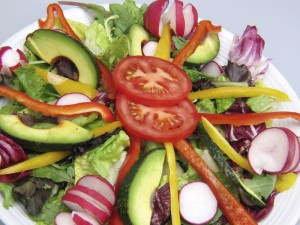 [1]s? If you add in boiled chicken breast, and some cheese, you can make it into a meal. Of course, who can forget the salad dressing? If you’re the type of person that cannot eat salad without some type of salad dressing, read on to find out 3 pitfalls to avoid with salad dressing:
1. Sugars in Salad Dressings: Salad dressings can be loaded with sugar. Did you know that the reduced-fat dressings usually have more sugar than the “regular” dressings? One example is Kraft Buttermilk Ranch Dressing, which has 2 grams of carbohydrates per serving, and its fat-free version contains 11 grams for the same serving size! In addition, some of the vinegar dressings also contain a lot of sugar in them. A tip to choosing salad dressings is to read the nutrition label to make sure that the sugary ingredients are not within the first 4 or 5 ingredients on the list. The ingredients are listed in order of amount on the nutrition label. Another tip is to use a little skim milk or water to thin out the thick salad dressings to dilute the calories and sugar.
2. Serving Size: We tend not to notice how much salad dressing we’re pouring onto our salads. In fact, how many of us pour salad dressing onto our salad while conversing with someone else? The calories in salad dressings can add up fast. Tips for keeping track of serving size:
- Use a measuring spoon until you can adequately eyeball two tablespoons of dressing
- Enjoy dressing on the side (Hint: Dip your fork into the dressing before the salad, you’ll use less dressing this way)
- Did you know an oil-based dressing coats salad really well? Put a small amount of an oil-based dressing in a bowl and toss the salad very well. The salad will have a more even coating of dressing this way.
3. Fat and Oil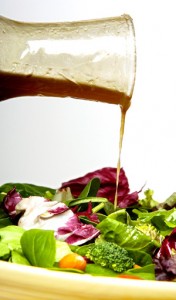 [2]s: Watch out for partially hydrogenated fat – they are almost entirely trans-fat. Even though trans-fat has mostly been dropped as an ingredient in salad dressings, there are still some in certain salad dressings. Also look out for saturated fat – diets high in saturated fat can increase incidences of atherosclerosis and coronary heart disease. Try to choose salad dressings that have a high amount of monounsaturated fats, which lowers the LDL cholesterol.
Too much salad dressing can add extra calories and fat. Instead of salad dressings, you can also squeeze some fresh lemon or lime juice you’re your salad. You can also use salsa! Make sure to use a variety of darker greens in your salad such as spinach, kale, dandelion greens, watercress, etc. Also, using a variety of colors of vegetables in your salad can add flavor, more nutritional value, and visual appeal without adding many calories.
What is your favorite salad ingredient.
By Mitzi Dulan [3] with research assistance from Rachel Yam [4]
 [5]
[5]